Showing posts with label PRUNING. Show all posts

17 March 2026

Pruning Makako almond trees

In late December and early January, during some of the coldest days of the year, we carry out the pruning of our almond trees, as described below. These are tasks that we perform in our spare time left by our main crops, which are cereals and pulse vegetables. Moreover, this is the ideal time of year, as the trees are about to start blossoming and the work that follows involves applying plant protection treatments to take care of them. Almond trees are pruned twice a year. The work described here corresponds to winter pruning, while the second pruning (spring pruning) will be discussed in due course.

Regarding pruning, we apply two types of training pruning, as we have Makako almond trees planted in 2023 and 2024. For the younger trees, pruning is simple: all branches are removed and the main trunk is cut back to the height where we want the crown to form. From that cut, the tree will sprout and start producing new branches. This will become the first tier or set of main branches. Usually, three main branches are formed, although in some cases we have left a few more.

As for the trees planted in 2023, they are now more established. Pruning is still focused on shaping the tree, but the aim is to determine where the second tier will be formed. As you know, almond trees sprout where the branch is cut. New branches grow from that point, forming the next tier. As shown in the video, the idea is to leave a branch about 40 cm long and then cut it. In this way, the tree gradually develops the desired structure.

Versión en español.


30 April 2025

Pruning in olive groves. Remove all the bad and keep the good

One of the key tasks we carry out once the cold winter weather has passed is pruning our olive grove. Normally, we begin this process in March, but this year, thanks to the abundant rainfall, we had to start, a little later, almost in April.

In this post we would like to share a brief summary of our pruning work, as well as comment on some tips and things to bear in mind when pruning olive trees. It can basically be summed up as ‘remove all the bad and keep the good”. But how do you know what to remove and what to keep? Each tree tells you.

First, it's important to understand the type of pruning you’re going to perform. Not all pruning is the same:

  • Creation (training) pruning for young olive trees.
  • Thinning pruning for trees in full production.
  • Renewal pruning for older olive trees.

In our case, we’ll focus on training and thinning pruning.

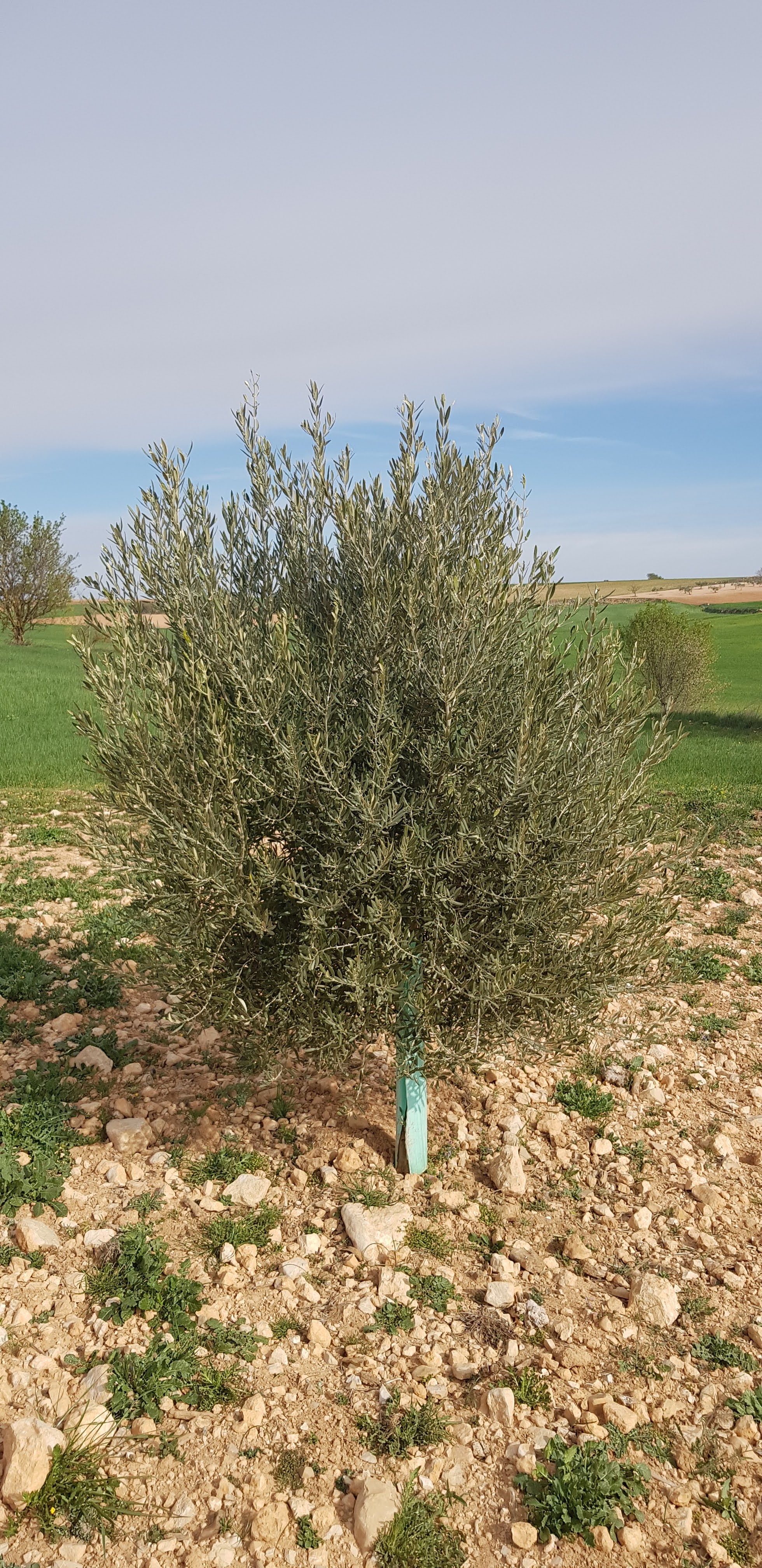
We apply creation pruning to olive trees up to six years old, with the goal of preparing them for mechanised harvesting using umbrellas.

The key objectives are:

  • Raise the main structure (cross) to a height that allows the harvesting machine to operate without interference.
  • Prevent lower branches from touching the canvas of the umbrella.
  • Structure the cross with two or three main branches.

This type of pruning is applied to olive trees over six years old and aims to maintain a balanced leaf-to-wood ratio.

Our main tasks include:

  • Removing excess wood (especially thick branches) to encourage more leaf growth, which is essential for olive production.
  • Eliminating vertical branches ("males") in favor of horizontal ones ("females"), which are more productive.
  • Observing the tree’s natural structure—because, as we always say, “the tree tells you what to cut”.

Some of the things to be considered in all types of pruning could be:

The olive tree must be well tucked in, i.e. it must not lose its leaves.

  • Pruning is based on removing what is left over to leave what is good, i.e. removing the ‘bad branches’ to leave the ‘good branches’.
  • Small branches should not be removed, i.e. thick branches should not be ‘sanded’.
  • Pruning varies according to the variety of olive tree.
    • A picual olive tree wants to be pruned aggressively to remove thick branches as it is a variety that tends to generate a lot of wood.
    • A white-leaved olive tree wants a less aggressive pruning to remove less wood as it is a variety with a fine wood structure.

To conclude, pruning is essential for maintaining productive and healthy olive trees. Whether training young trees or thinning mature ones, the goal is always the same: remove the unnecessary to strengthen what matters—and let each tree guide your hand.

Versión en español.

15 April 2024

Olive pruning. Things to bear in mind

In the middle of the olive pruning campaign, we pause our tasks to provide a summary of  our progress. Following the guidance of our advisor, Rafael Navarro, and drawing from our experience last year, we are currently engaged in pruning and shredding branches, with plans for a pre-flowering treatment to follow.

Regarding pruning, we encounter three different scenarios: young olive groves, medium-sized olive groves and old olive groves. Each one needs to be pruned in a different way, which is explained below. Regardless of the age of the olive tree, the following basic concepts should always be kept in mind:

  • Pruning consists of removing bad wood so that good branches can grow.
  • The aim is to harvest more olives from the same pruning year.
  • Pruning is not peeling branches. Density is removed, but you remove firewood, not small branches.
  • Remove unnecessary branches.
  • Male branches at high altitude are useless.
  • The olive tree must always be kept in the correct shape.
  • It is necessary to attack the vertical branches, branches that go too far outwards, but the twig is fundamental.

For our young olive grove, planted in 2017 but unfortunately affected by the storm Filomena in 2021, our work primarily focuses on:

  • Removing low branches to shape the olive trees.

Regarding the medium-sized olive grove, planted in 2018, the tasks include:

  • Removing low branches.
  • Pruning male branches (those growing vertically).
  • Thinning out inner branches to allow light penetration and prevent leaf loss due to lack of light.

Finally, for the old olive grove (about 30 years old), our work involves:

  • Thinning out some main branches, aiming to retain three main branches, though this may change over time.
  • Clearing inner branches to promote light penetration.
  • Pruning male branches to reduce height and facilitate a more accessible harvest, as olives are typically found on lower branches

In conclusion, proper pruning techniques tailored to the specific age and condition of olive trees are essential for ensuring optimal growth, health, and productivity. Are you currently undertaking any pruning activities in your olive grove? Share your experiences or questions in the comments below!

Versión en español.

14 April 2023

Pruning Picual olive groves

A few days ago we attended a pruning course conducted by Rafael Navarro (a great expert in the world of olive growing) in our olive grove. It was a very interesting day that has allowed to us to develop a methodology to prune our Picual olive grove. One of the initial things to keep in mind is that the olive variety determines the pruning to be carried out: the Picual variety wants to remove the fat branches and not the thin ones. With other varieties like Manzanillo or even Arbequina, for example, where the olive tree asks for just the opposite. 

In our video you have more details of what you need to know when pruning a Picual olive tree. Here are the main steps to follow: 

  • Fix the cross between waist and chest.    
  • The cross consists of two opposite branches or three at the most. These branches (life branches) must have angles of 45° to 60°. Therefore, horizontal branches will be branches that will be removed, also called death branches. 
  • Note also the parallel branches (flats). If we see that there are parallel branches in the same orientation, some of them should be removed. 
  • The aim is to make room for the life branches to grow. If any branch is crossed, it is a candidate for a death branch. 
  • Pruning should not be too aggressive so that the olive tree does not show any major damage. Aggressive pruning can lead to massive generation of branches in the lower zone and branches that grow vertically. 
  • The lower thin branch with large leaves (female branches) should not be removed as this is where most of the olives are produced. Candidate branches to be removed during pruning are the high branches with small leaves (male branches) as these will not produce olives. 
  • North-facing branches are also candidates for death branches. In this way we force the olive tree to regenerate in that part of the tree where it has less light. 
  • The pruning of the Picual olive grove is normally done with a chainsaw and not with scissors, as the aim is to remove thick branches. 

Finally, we would like to list the tools used. Every job needs the right tool to be performed quickly and comfortably. On this occasion we have used the tools that Agriman has sent us, which are as follows: 

We have really enjoyed working with the F3020M electric shears as they offer total comfort when cutting branches. When you want to cut thicker branches, a small and light saw like the one we have used provides excellent manoeuvrability... pruning is very easy to do without getting tired and it is even a fun job.

Versión en español.