Showing posts with label SPRAYING. Show all posts

31 March 2026

Fertiliser, roller and weeder for cereals

Over the past few weeks, despite rainy and windy conditions, we have completed the remaining tasks on the cereal fields: fertiliser application, rolling, and weed control. With this work finished, the next machine to enter the fields will hopefully be the combine harvester. As usual, we like to carry out these operations in the order mentioned in the title.

Regarding fertilisation, in recent years we have been using YaraVera™ AMIDAS with excellent results. This year we’ve had to make a change, since the fertiliser used often depends on availability at the supplier’s warehouse. We therefore applied ENTEC® EVO™ 24 (+15 SO₃), which contains sulphur, at a rate of 225 kg/ha. Together with the basal fertilisation applied at sowing, this provides enough nitrogen for a good yield, provided rainfall conditions remain favourable.

Once the fertiliser has been applied, the next step is rolling the ground. This process serves three main purposes:

  1. To consolidate the soil and improve root–soil contact
  2. To press down stones, reducing potential issues during harvesting
  3.  To help incorporate the fertiliser and reduce losses due to exposure

Finally, for cereals, we carry out phytosanitary treatment to eliminate broadleaf weeds. As it has been a very wet winter this year, we’re taking this opportunity to apply a fungicide, which will help maintain plant health.

The following products were used:

  • Dingo (2,4-D 30% + Florasulam 0.62% w/v. SE). Dosage: 0.7 l/ha
  • Trimur (Tribenuron-methyl 75% WG). Dosage: 15 g/ha
  • Geriones (Tebuconazole 25% w/v EW). Dosage: 0.5 l/ha

With all these tasks completed, the crop is now well established and on track for the coming months. From here on, the weather will play a key role, so we will continue to monitor the fields closely and hope for a favourable season ahead. Here are a few videos of these works... we hope you like them.

Versión en español.

15 March 2024

Automated spraying

Nowadays, there is a high demand for automated machines that streamline work processes These machines are designed to perform tasks more efficiently and therefore save costs. On the other hand, these machines are more expensive than manual ones (due to the presence of extensive electrical and electronic components), but in the long run the savings are considerable. Of course, the more frequently the machine is used, the sooner the return on investment is achieved... if the machine is heavily used, the amortisation is faster.

The optimal choice is to have an ISOBUS machine, but this also requires having a tractor equipped for it. This can be done either by installing ISOBUS on the tractor directly or using the ISOBUS kit compatible with the GPS equipment already present on the tractor. Alternatively, converting an older machine to ISOBUS is possible but this is also usually an expensive action.

Another interesting option (and much cheaper than converting to isobus) is the spraying module offered by the manufacturer Hexagon to automate machines (sprayers, seed drills, spreaders, etc.). This module converts a manual machine into a fully automated machine, allowing us to make variable doses according to the speed, automatic control of sections according to overlaps, doses according to a pre-registration map or yield, etc... everything we can think of on Agriculture 4.0. Definitely a good option for users who have Hexagon equipment on their tractor.

The main features of the spraying module are:

  • Compatible with any old and current machine.
  • Control of up to 16 sections.
  • Easy installation and even reversible if you ever want to return to the original state of the machine.
  • Compatible with all Hexagon displays: Ti5, Ti7 and Ti10.
  • Easy to set up and use from the Hexagon screen.
  • Also allows the machine to be controlled manually.

What are your thoughts on ISOBUS technology? Do you have any machines that use this technology? Please let us know; we look forward to reading your comments.

Versión en español.


13 October 2023

Olive grove. Autumn treatment

In this article we are talking about the third phytosanitary treatment in the olive grove this year. Since, we have already shown you the fruit set (June) and pre-flowering (April). On this occasion, we go with the autumn season, which in addition to nutrition, we are taking advantage to prevent some diseases such as the olive fly. In each treatment, the products we use to optimize the growth and development of the olive tree and the olives are different, always following the recommendations of our advisor Rafael Navarro. This time the treatment is based on copper and potassium sulphate, although we use other products to help nourish the tree and fatten the olives.

This autumn treatment is usually takes place in October, but this time we had to advance it until the end of September as we have had rain and the humidity could bring forward the arrival of the olive fly. In this respect, we have carried out a preventive treatment with the product Sikori (from Tradecorp) based on the active ingredient Acetamiprid. As you can see in the photos, the olives this year look superb... or maybe they did.

We say they had, because a few days ago we had some hail and many of the olives fell to the ground and others were damaged. We believe that it was not a major problem, but it will certainly have an impact on this year's yield, which seemed to be optimal. The last pictures show the state of the olives after the hail.

After this, there is little work left until the harvest: some manure spreading on some fields and soil management to control weeds... We will show you this work and give you a summary of the year.

Versión en español.

10 May 2023

Phytosanitary treatment by drone

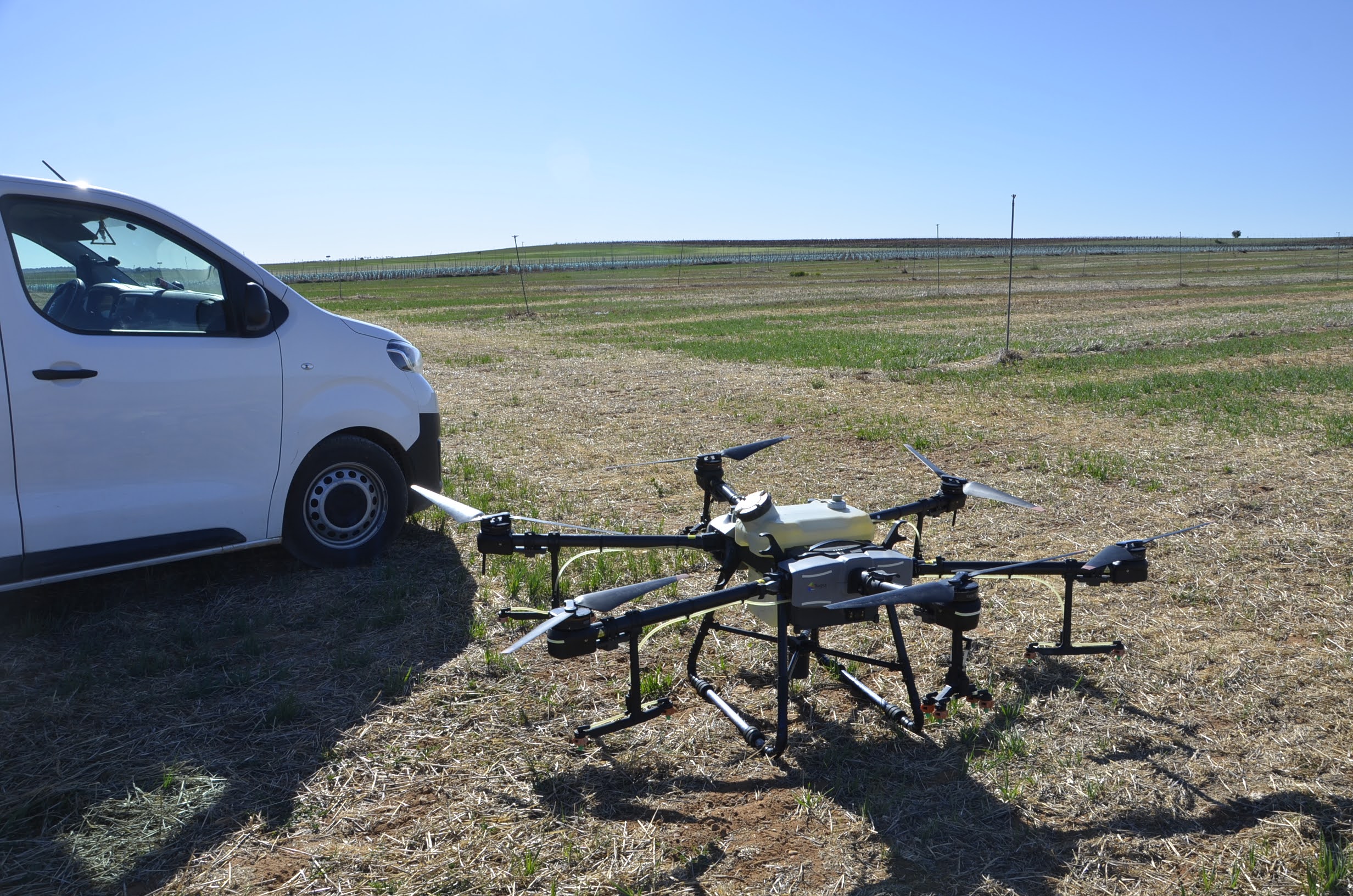
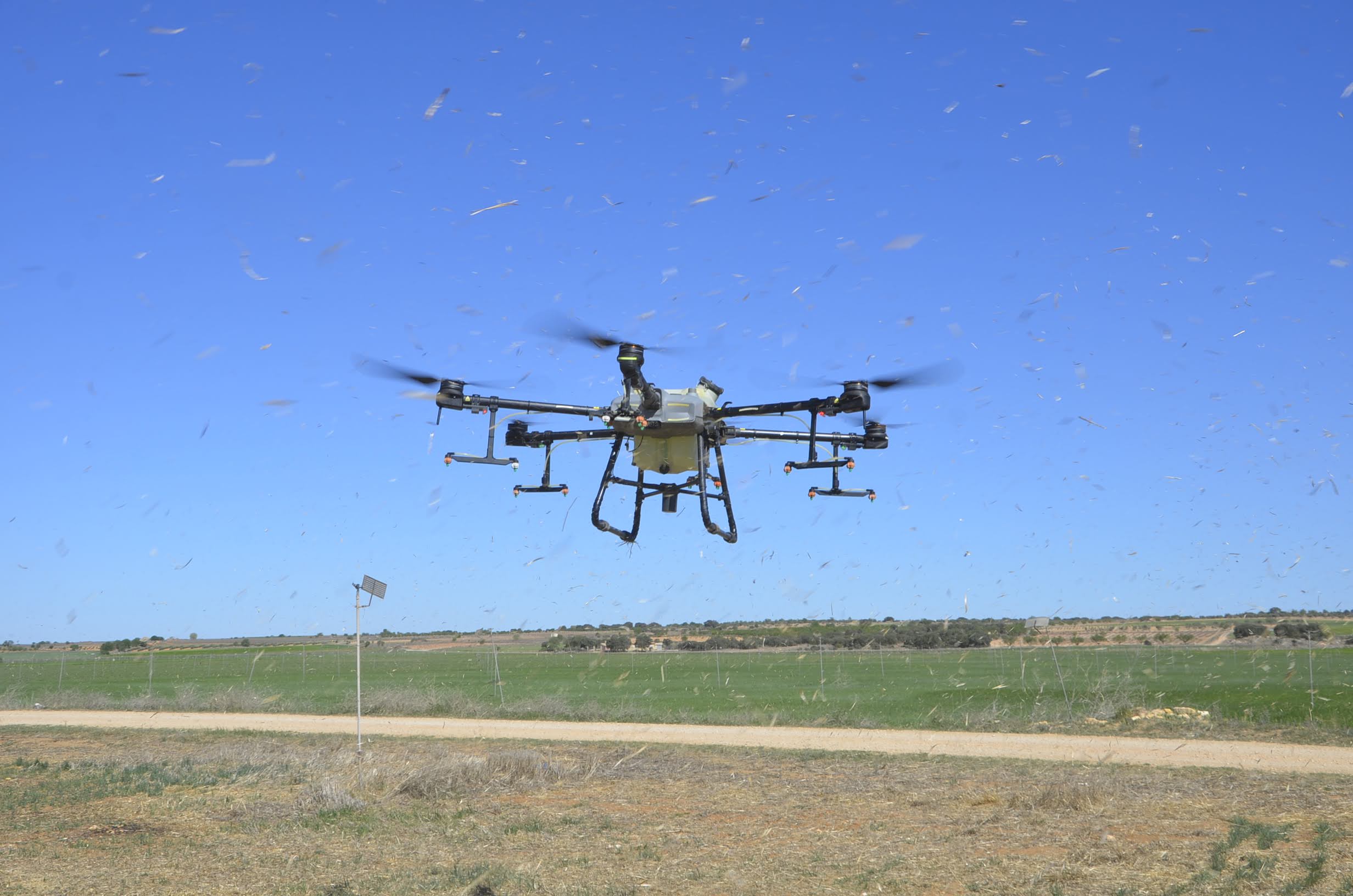
Our friend Luis Alcázar, from the company Pulveriza Dron, offered us to visit him at his work with the DJI Agras T30 drone. It was the first time we saw an agricultural drone working. The morning was very interesting as we were able to learn about the working process of the device... but let's take it step by step. 

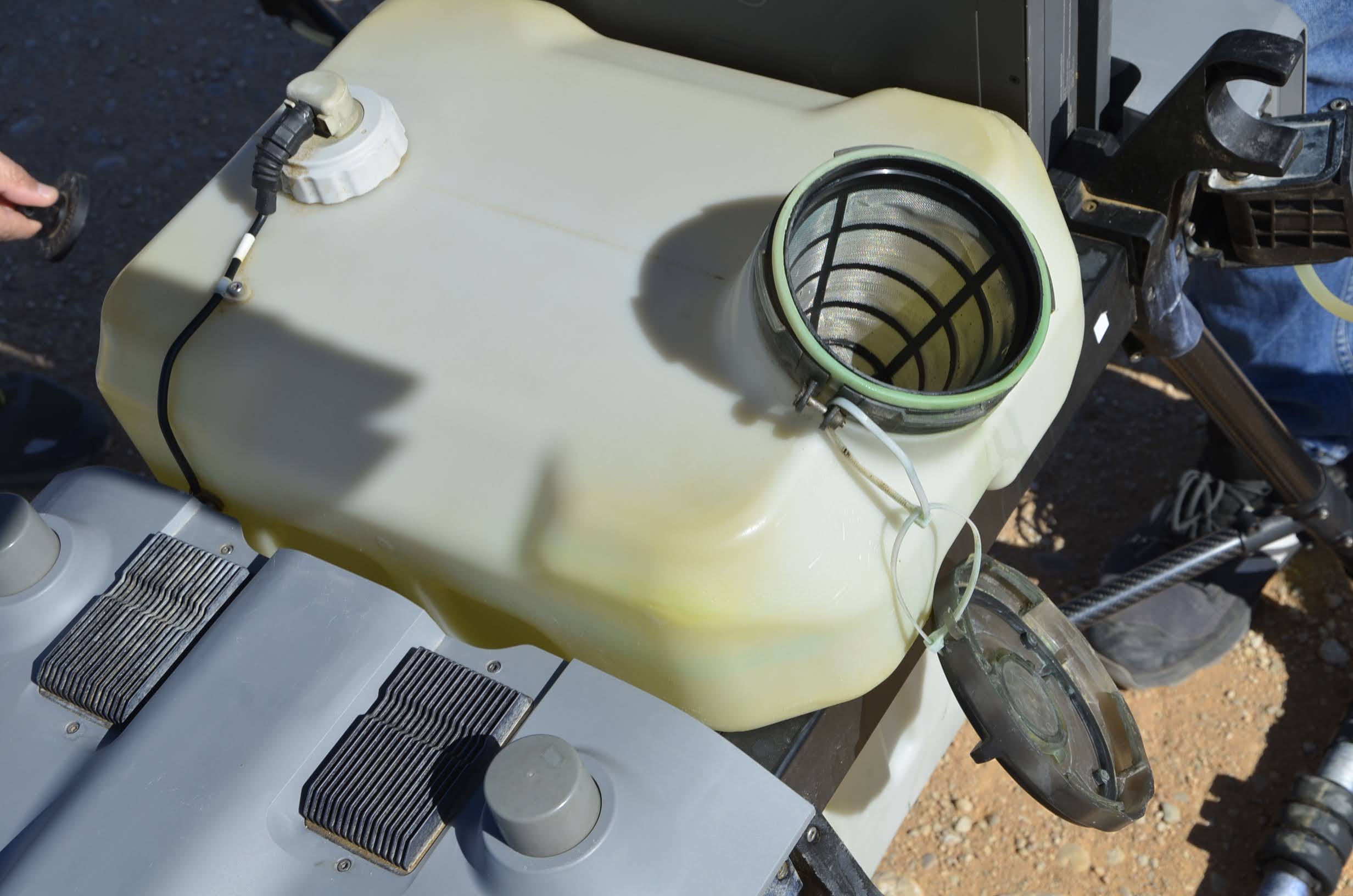
First of all, before making the flight, it is necessary to setting the program the flight so that the work is almost automatic. To do this, you have to geolocate the field and configure the working width as well as different parameters according to the work to be done, the type of crop, etc. Once the drone is ready to fly, it should be noted that the batteries last about 6 minutes and therefore that will be the time to empty the 30 litre tank the drone carries (there is also a tank for solids which is similar to a small fertiliser spreader). It is important to have several batteries and a generator that recharges them in order to be able to work a full day. 

Secondly, the plant protection product to be used in the treatment must be prepared. This product is usually mainly active material, but water is also used to make a correct mixture. This mixing is usually done in an auxiliary tank of 500 litres and one of the operators oversees supplying the liquid while the other changes the batteries... two people usually work with the drone: pilot and handler of phytosanitary products. 

Finally, our impression was that it is a tool to be taken into account for crops or situations where you cannot enter with the tractor or Unimog (high crops, muddy or waterlogged areas, etc.), it is a perfect solution. In addition, in high-yield crops (irrigated cereals, etc.), it is an advantage as it does not damage any part of the field (tractor ruts) and therefore you have more yields, the crop is uniform in its entirety and harvesting task is easier.

Versión en español.